The summer cabin in 1948
Out Stealing HorsesThe summer cabin in 1948 is both a practical rural home and the setting through which Trond remembers a summer of closeness with his father, risky adventures with Jon, and the first intimations of loss. Set beside a fast river near the Swedish border, it joins ordinary work and family life to a landscape that had also served as cover for wartime resistance. Years later, Trond’s account of the place remains vivid but admits that memory has filled in some of its past.
Setting and approach
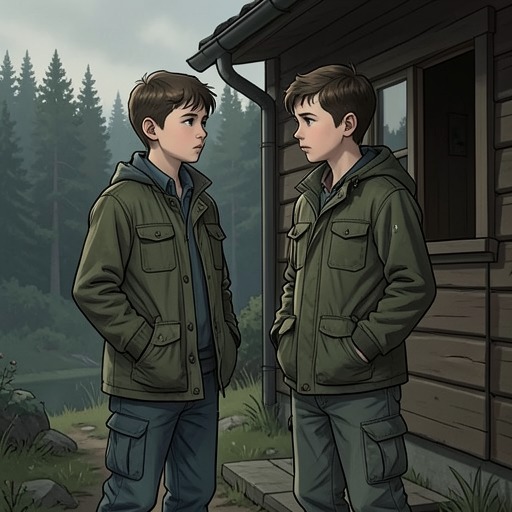
Trond is fifteen in 1948, staying at the cabin with his father during the first days of July. His father had bought it after saving money through work that Trond never fully understood: his jobs changed, and involved tools, small machines, planning, and journeys around Norway. When they first visited the previous year, his father walked the property, inspected it, patted the trees, and sat on a large stone by the water as if among old friends. Trond could not know what the place meant to him, or whether the father’s apparent familiarity was real.
The cabin stood within land that ran from the riverbank through forest and pasture to a narrow, sparsely gravelled road. Spruce and pine crowded the property, with occasional birch trees between them. A wooden cross was nailed to a pine at the pebbled edge of the water, almost overhanging the current. The forest curved around the yard, cottage, shed, and meadow, while the road connected the property to a wooden bridge and the village shop and church. The river was close enough to be seen from the kitchen window, but the boys’ most dangerous river play began farther downstream.
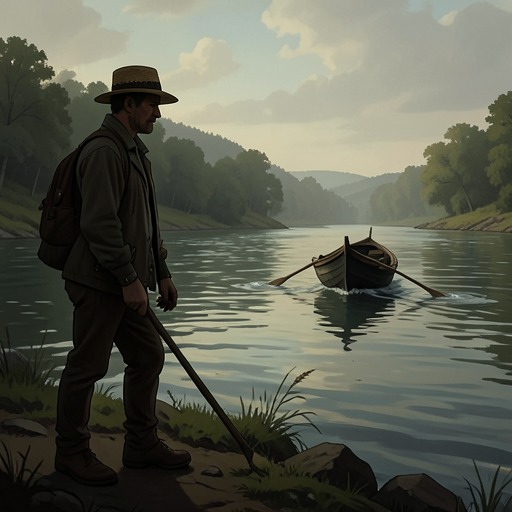
There were two ways to reach the village. Trond and Jon could walk across Barkald’s field beside its fence and row over the river, or take the longer track that passed the bridge. If their boat had been left on the wrong bank, the route could change; Trond acknowledges that he was usually responsible. The cabin’s relative seclusion was therefore not isolation from the district but a particular position within its network of roads, fields, crossings, and neighbours.
Domestic life and summer work
The cabin’s interior is remembered through practical details. A wood stove warmed the main room; a paraffin lamp lit the table; a rag rug lay by the door, and bunks provided the sleeping places. After one rain-soaked return from the river, Trond paused on the porch under its small eave, smelled bacon frying, and entered dripping onto the rug. His father was at the stove making breakfast, wearing an old sweater full of holes and growing a beard he described as hairy and free. The warm, ordinary scene contrasts with the boy’s cold and the storm outside, and with the father’s silence about the war.
The grounds also demanded work. Trond later understands that his father needed money and had the trees felled for timber. In 1948, the work was done by several men using a cross-cut saw and hatchet, with a trained horse and a chain-tow to haul the logs to the riverbank. They stripped the bark, rolled the timber into the water with pike poles, and sent it downstream. Decades later, Trond sharpens and uses a chainsaw on a dead spruce at his own home, reflecting that such one-man saws had not reached Norwegian forests in 1948. The remembered cabin is thus linked to a way of working in which tools, animals, labour, and the river formed one process.
Companionship and danger
Jon repeatedly came to the cabin door to draw Trond out. The boys hunted hares, walked by moonlight to the ridge, fished for trout, and balanced on yellow logs moving downriver. They began nearly a kilometre from the cabin; sometimes, after scrambling ashore soaked and shivering, they had an hour’s walk home through the forest. Trond never refused Jon and concealed their activities from his father. The cabin offered a home base for these excursions, but the boys’ shared secrecy made their friendship feel like a separate life within the summer.
Their first expedition to steal horses begins from the cabin, where Jon proposes the adventure. The boys pass through the fields toward Barkald’s farm, imagining the danger through the cowboy stories they have read and behaving, in their own eyes, like criminals. Barkald’s four horses are kept in a large forest enclosure fenced with barbed wire. The farm’s scale and its owner’s wealth stand out in a district where most families are smallholders, including Jon’s. The cabin’s closeness to the farm makes the landscape a field of both play and social difference: the boys can cross it freely, but they know the horses belong to someone else.
Wartime history and remembered absence
The cabin’s setting carries a history Trond did not know during the summer. In 1942, his father had sought a place near the Swedish border where he could take cover while carrying papers, letters, and sometimes films for the Norwegian Resistance. He presented his need for a place to think as an ordinary explanation. Franz alone knew the real purpose. A German patrol occupied a nearby farm, and a guard sometimes watched the gravel approach to the bridge. Trond’s father crossed that route by talking with the guards in German, learning about them, and appearing to be a harmless local handyman. He also used the fields and a boat to cross the river. The village’s routines and its informal observation of one another made concealment dangerous; Jon’s mother and Franz sometimes carried the final part of the traffic across the border.
This wartime history concerns the same border district, but Trond receives it later from Franz and does not establish that the cabin he shared with his father in 1948 was itself the wartime hiding place. The distinction matters to the way the setting works in his account: familiar paths and crossings acquire a second history without becoming a fully solved map. Trond’s father had never discussed the war with him, and the boy had not known how often his father had been in the village during the occupation.
The cabin is also the place where Trond first confronts his father’s absence as something he cannot explain away. After his father says he will follow him to bed, Trond wakes during the night and finds him gone. The father’s bunk is made and neat, as it has been since the previous morning. Trond later recalls dressing beside the still-warm stove, listening to the summer night and recognizing that the confidence with which he had accepted his father’s earlier absences had been shaken. In another remembered scene, his father is again missing from the cabin, and Trond returns to find him making breakfast. The domestic room offers welcome, but it cannot tell the boy where his father has been.
Memory and significance
Trond explicitly questions how much of the past he has reconstructed. His father could not have supplied every detail of the shooting that killed Odd, yet the scene is printed in Trond’s memory; he cannot tell whether he began completing the picture at once or did so over the years. The cabin’s kitchen table becomes the setting in which his father looks to him for a sensible response, while Trond sees Jon’s white face and remembers him pushing a boat into the current. The physical room anchors a story whose emotional facts feel certain even when the route by which they entered memory does not.
That tension gives the cabin significance beyond shelter. It is a place of meals, work, and a boy’s summer freedom, but also the point from which the surrounding river and forest open onto hidden wartime journeys and irreversible loss. In the older Trond’s recollection, its details—lamp, stove, bunk, timber, path, and crossing—do not make the past transparent. They give it a tangible shape while leaving the father’s private history and the full construction of memory unresolved.